$2.1B
North American kombucha market in 2025, with the U.S. representing approximately 85% of total regional sales
INDUSTRY SOLUTION
The fermented beverage market rewards brands that can scale fast without losing product integrity. DPS engineers complete kombucha brewery designs and fermented beverage facilities — from SCOBY-safe fermentation environments and precision temperature control through packaging-ready CIP systems — serving producers in all 50 states and Canada. We build the infrastructure that turns live-culture complexity into repeatable, profitable production.
Schedule a Consultation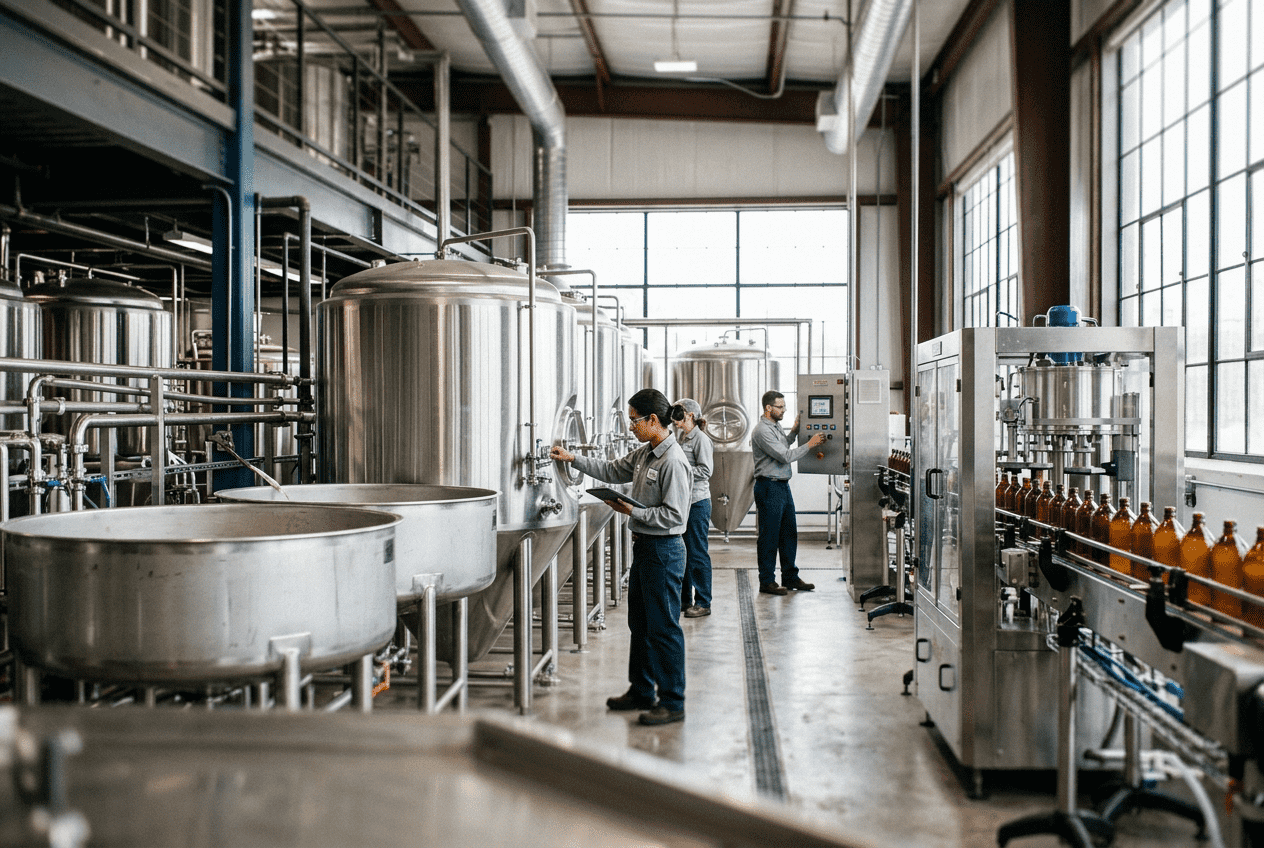
Industry Overview
The North American kombucha market reached approximately $2.1 billion in 2025, with the U.S. commanding roughly 85% of regional volume, and overall growth continues at a double-digit compound annual rate. But underneath the growth headline lies a structural challenge: the Midwest and Southeast are showing the fastest expansion at 24–28% year-over-year, driven by mainstream retail penetration through Walmart, Target, and regional grocery chains — yet most existing kombucha production capacity remains concentrated on the West Coast, which still holds about 42% of market share. For producers chasing national distribution, the facility gap is the bottleneck.
What separates a kombucha brand that plateaus at regional distribution from one that achieves national scale is not the recipe — it is the fermented beverage facility behind the recipe. Commercial kombucha production is a controlled biological process where fermentation behavior changes dramatically above 1,000 liters. SCOBY health, pH stability, alcohol control below the critical 0.5% ABV threshold, and batch-to-batch flavor consistency all become exponentially harder to manage without purpose-built fermentation infrastructure, jacketed temperature control, automated CIP systems designed for live-culture environments, and controls that monitor every critical parameter in real time. Many kombucha startups outgrow their original equipment within 12–24 months. The producers who invest in scalable, compliance-ready facility engineering from the outset are the ones who capture the growth without costly mid-stride rebuilds.
$2.1B
North American kombucha market in 2025, with the U.S. representing approximately 85% of total regional sales
0.5% ABV
The federal threshold that determines FDA vs. TTB jurisdiction; exceeding it at any point during production requires a TTB-qualified facility
7–14 Days
Typical primary fermentation cycle for commercial kombucha, making tank utilization and fermentation scheduling direct drivers of facility throughput
24–28% YoY
Growth rates in Midwest and Southeast U.S. markets, signaling urgent demand for new fermented beverage production capacity outside the West Coast
Key Deliverables
Practical engineering solutions designed to improve efficiency, scalability, and operational performance.
DPS designs kombucha brewery environments where SCOBY cultures thrive at production scale — closed, jacketed 304/316L stainless steel fermentation vessels with precision glycol-based temperature control holding the 75–82°F sweet spot that drives consistent acidification without alcohol overshoot. We engineer tank farm layouts with staggered batch scheduling built into the floor plan, so your facility supports continuous harvesting rather than the start-stop cycles that strand capacity in idle tanks.
The 0.5% ABV line is not just a labeling detail — it determines whether your facility falls under FDA food safety regulation or TTB alcohol beverage requirements, and that classification shapes everything from facility permitting to production SOPs. DPS engineers fermentation monitoring, temperature management, and process controls that give you documented, auditable control over alcohol development at every stage, whether you are producing non-alcoholic kombucha, hard kombucha, or both product lines from the same facility.
Standard dairy or brewery CIP protocols can damage SCOBY cultures and leave chemical residues that compromise fermentation performance. DPS designs and manufactures CIP systems — from our own fabrication facility — calibrated for the specific sanitation requirements of live-culture fermented beverages: hot-water sanitization cycles per FDA Food Code guidelines, acid-compatible materials, and automated sequencing that ensures every tank, transfer line, and valve receives verified cleaning without chemical carryover into the next batch.
With flavored varieties accounting for over 70% of retail kombucha sales, your facility must handle dozens of SKUs without cross-contamination or recipe drift. DPS programs PLC-based batch control and SCADA monitoring systems that manage primary fermentation parameters, secondary carbonation profiles, flavor dosing, and pH/temperature logging — all with recipe management that lets your team switch between products on a single production platform while maintaining the traceability records that SQF and BRC audits demand.
DPS builds phased expansion roadmaps tied to your production volume targets and retail distribution timeline — not generic construction milestones. Your Day One facility is fully operational, while structural loads, utility mains, glycol loop capacity, and floor space are pre-engineered for Year Two and Year Four expansions, so scaling from 5,000 to 50,000 gallons per month never requires tearing out infrastructure you just installed.
DPS vs Traditional
Kombucha production sits at the intersection of food science, fermentation biology, and federal regulatory compliance — a combination that punishes fragmented project delivery. When your process engineer, equipment vendor, controls programmer, and general contractor operate on separate contracts with separate assumptions, the result is facilities where fermentation environments do not match the CIP design, utility capacity cannot support peak production, and alcohol control systems lack integration with the actual process flow. DPS eliminates that coordination failure.
Scroll horizontally to compare every column on smaller screens.
| Dimension | DPS Integrated Approach | Fragmented / Traditional Model |
|---|---|---|
| Fermentation Environment Design | Tank specifications, temperature control, SCOBY management protocols, and room HVAC co-engineered as a unified biological system by the same team | Equipment vendor supplies tanks, separate HVAC contractor installs climate control to generic specs, fermentation performance issues discovered after first production runs |
| Alcohol Compliance Infrastructure | Fermentation monitoring, process controls, and documentation systems designed together to maintain auditable ABV control under both FDA and TTB frameworks | Controls integrator programs monitoring to secondhand specifications; compliance gaps identified during TTB review or product testing, triggering costly retrofits |
| CIP & Sanitation Systems | DPS-manufactured CIP skids designed specifically for live-culture fermented beverages, with chemical-free sanitization options and automated verification sequencing | Off-the-shelf CIP system designed for dairy or brewing; chemical residues affect SCOBY health, cleaning validation documentation incomplete for food safety audits |
| Multi-SKU Production Flexibility | Process piping, flavor dosing, carbonation, and batch control designed from the outset for 20+ SKU production with automated changeover and cross-contamination prevention | Facility built for a single product type; adding flavors or new product lines requires manual reconfiguration, additional piping, and ad hoc controls modifications |
| Utility Sizing for Growth | Glycol, compressed air, process water, wastewater, and electrical service sized for Phase 2 capacity on Day One — expansion requires connecting to pre-engineered infrastructure | Utilities sized for current demand only; every capacity increase requires shutdowns, contractor mobilization, and utility infrastructure upgrades |
| Schedule & Accountability | Single Design-Build-Manage contract with one point of accountability — DPS owns the timeline from engineering through commissioning | 4–6 separate contracts with independent timelines; delays in one trade cascade through the entire project, pushing facility commissioning past market windows |
Project Verification Questions
Our fermented beverage facility projects range from approximately $400K for targeted upgrades — adding fermentation capacity, installing a new CIP system, or retrofitting temperature control infrastructure — up to $5M+ for comprehensive greenfield kombucha brewery builds that include fermentation, blending, carbonation, packaging, and utility systems. Every project starts with a capital feasibility study that models your investment against production volume targets, SKU mix, and distribution economics. If the numbers indicate that a process optimization or operational adjustment can solve your problem more effectively than a capital project, we will tell you that directly — we have resolved multi-million-dollar capacity constraints with PLC adjustments that cost clients nothing beyond the initial assessment.
This is one of the most consequential engineering decisions in any kombucha facility, because exceeding 0.5% ABV at any point during production — even temporarily — subjects your operation to TTB alcohol beverage regulation, regardless of your finished product’s ABV. DPS engineers fermentation temperature control, process timing, and real-time monitoring systems that give you documented control over alcohol development throughout the production cycle. Our PLC-based controls log pH, temperature, and fermentation duration at every critical control point, creating the auditable records that demonstrate compliance to both FDA and TTB during inspections.
Fermentation behavior changes dramatically as vessel size increases past 1,000 liters — temperature gradients become more pronounced, SCOBY formation patterns shift, oxygen diffusion rates change, and the risk of contamination multiplies with every additional transfer point. DPS engineers scaling transitions that address these biological realities: jacketed vessels with multi-zone temperature control, closed-system transfers that minimize contamination exposure, and facility layouts designed for staggered batch scheduling that maximizes tank utilization. We also engineer your Day One facility with the structural, utility, and spatial capacity for your Year Three production targets already built into the infrastructure.
Yes, and dual-product capability is increasingly common as the hard kombucha segment grows at over 18% annually. The key engineering challenge is maintaining clean regulatory separation between non-alcoholic production (FDA jurisdiction) and alcoholic production (TTB jurisdiction) within a single facility — separate fermentation zones, independent process controls, distinct documentation systems, and compliant premises qualification. DPS designs shared utility and CIP infrastructure that serves both production zones efficiently, while maintaining the physical and procedural separation that satisfies both regulatory frameworks.
A targeted expansion or retrofit — adding fermentation tanks, upgrading CIP, installing automation — typically runs 4–8 months from engineering kickoff through commissioning. A full greenfield fermented beverage facility runs 10–16 months depending on scale, permitting complexity, and equipment lead times. DPS manages this as a single Design-Build-Manage engagement where we own the schedule end-to-end. Because we manufacture key equipment — tanks and vessels up to 12,000 gallons, CIP skids, and process systems — in-house, we control critical-path lead times that external equipment procurement often delays by months.
We Build Profitable Projects
Whether you’re exploring a greenfield facility, expanding an existing line, or upgrading your process systems — DPS delivers honest, rigorous engineering. Let’s start a conversation.
Discuss your engineering, equipment, or facility plans with the DPS team.
Contact Our Team