Disruptive Process Solutions丨DPS
English

Service

Custom Process Equipment Built for Your Exact Production Line

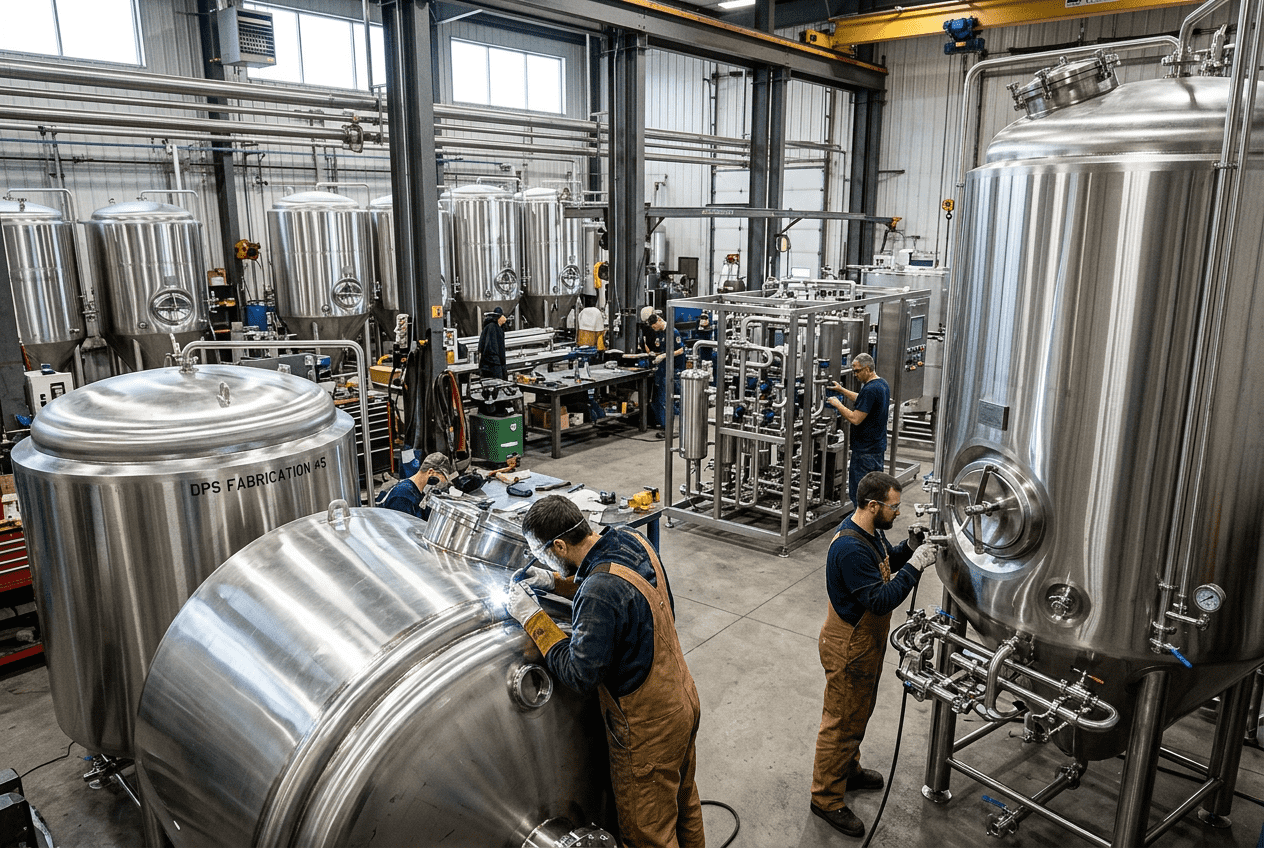
DPS manufactures stainless steel tanks, vessels, CIP systems, and specialty process equipment designed, fabricated, and integrated as part of a complete food or beverage facility project — not sold as catalog items disconnected from your actual production reality. When your equipment is engineered by the same team that designs your process, builds your facility, and commissions your line, every weld, every nozzle placement, and every instrument connection exists for a reason tied directly to your throughput and profitability.

Schedule A Consultation
Sanitary food processing equipment manufacturing and supply

DPS · Equipment Manufacturing & Supply

Construction Risk Factors

Challenges in Providing This Service in the Market

Food and beverage manufacturers spend significant capital on process equipment every year, and the majority of that equipment is purchased in isolation — specified from a catalog, quoted by a sales representative who has never visited the facility, and delivered to a loading dock where a separate contractor figures out how to make it fit the existing process. The gap between what an equipment vendor delivers and what a production floor actually requires is where projects bleed money, lose weeks, and introduce risk that compounds through every downstream phase of construction and commissioning.

  1. Challenge 01

    Specification misalignment

    Standard catalog vessels and tanks are designed to serve the broadest possible market, not your specific batch sizes, temperature profiles, CIP circuit configurations, or headspace requirements. Manufacturers routinely accept equipment that is 15–30% oversized or undersized for the actual duty because no off-the-shelf option matches the process engineering. That mismatch costs you in energy consumption, chemical usage, cycle times, and floor space for the entire operational life of the asset.

  2. Challenge 02

    Integration burden transferred to the owner

    When equipment arrives from one vendor, process piping from another, and controls from a third, the owner inherits responsibility for making those three scopes connect — mechanically, electrically, and logically. Nozzle orientations that conflict with piping runs, instrument connections that require adapter fittings, control panel wiring that does not match the integrator’s I/O list — every interface between independently sourced components generates field rework billed at construction-phase labor rates.

  3. Challenge 03

    Lead time unpredictability

    Imported stainless steel vessels from overseas fabricators carry lead times of 16 to 28 weeks with limited owner visibility into production status, quality control processes, or shipping logistics. A single delay in vessel delivery can cascade across an entire facility construction schedule, idling trade crews, pushing commissioning past seasonal demand windows, and deferring revenue by months.

  4. Challenge 04

    Quality verification gaps

    Equipment manufactured offshore or by vendors without direct food-industry process engineering expertise frequently arrives with weld quality, surface finish, or dimensional tolerances that do not meet 3-A Sanitary Standards or the specific requirements of FDA and USDA-regulated production environments. Discovering these deficiencies at the point of installation — after the vessel has shipped across an ocean — leaves the owner with limited recourse and expensive field remediation.

The DPS Solution

Building Scalable and Efficient Production Systems

DPS manufactures process equipment as an integrated discipline within the Design-Build-Manage model — not as a standalone product line. Every tank, vessel, CIP skid, tumbler, and kettle that leaves our fabrication program exists because a DPS process engineer specified it against a defined P&ID, a defined batch recipe, a defined facility layout, and a defined commissioning sequence. The equipment is not adapted to the project after purchase; it is created from the project’s engineering requirements from the first weld to final hydrostatic test. This approach eliminates the specification gap, the integration gap, and the coordination gap that define conventional equipment procurement in food and beverage manufacturing.

Our custom fabrication capabilities encompass stainless steel tanks and pressure vessels up to 12,000 gallons, complete CIP systems engineered to your specific soil loads and circuit configurations, marination tumblers, processing kettles, and specialty vessels for applications including fermentation, blending, batching, cooking, and storage. Every unit is fabricated to 3-A Sanitary Standards with surface finishes, weld quality, and dimensional tolerances verified before shipment. Because DPS also performs the process piping, controls integration, and commissioning on the projects where this equipment is installed, we design every nozzle location, every instrument port, every support leg height, and every lifting lug position to align precisely with field installation conditions — not to satisfy a generic arrangement drawing.

DPS equipment manufacturing is based in the United States, giving clients direct access to our fabrication team for design reviews, in-process inspections, and accelerated delivery schedules that are impossible to achieve with offshore suppliers. Current equipment revenue represents approximately 5% of DPS total revenue and is scaling rapidly as clients recognize the cost and schedule advantages of sourcing process equipment from the same firm that engineers and builds their facility. For manufacturers operating across multiple sites nationally, DPS provides equipment supply with consistent quality standards and engineering documentation across all 50 states and Canada.

Key Capabilities

Capabilities Supporting Modern Production Operations

Integrated engineering, operational, and project capabilities designed to support efficient, scalable, and reliable production environments.

PLC Programming & Logic Development

Custom ladder logic, structured text, and function block programs developed on Allen-Bradley, Siemens, and other major platforms for process control, safety interlocks, and high-speed sequencing across food and beverage unit operations.

SCADA System Design & Deployment

Full supervisory control and data acquisition architecture including server configuration, real-time process visualization, historical trending, and role-based access designed for multi-line F&B production environments.

Recipe Management & Batch Control

ISA-88-aligned recipe structures that allow production teams to manage formulations, ingredient scaling, and batch sequencing directly from the HMI — reducing changeover time and eliminating manual transcription errors.

CIP/SIP Automation & Validation

Automated clean-in-place and sterilize-in-place sequences with full parametric data logging for FDA and USDA compliance, integrated with process scheduling to minimize non-productive time between production runs.

Energy & Utility Management Systems

Real-time monitoring and automated control of boiler, compressed air, glycol, refrigeration, and HVAC systems to reduce per-unit energy cost while maintaining critical environmental parameters in temperature-sensitive processing areas.

Controls Integration & Retrofits

Integration of new automation layers into existing brownfield facilities — migrating legacy relay logic or outdated DCS platforms to modern PLC/SCADA infrastructure without extended production shutdowns.

The DPS Integrated Advantage

Engineering Scope & Deliverables

The following table summarizes DPS equipment manufacturing parameters across our primary product categories. All specifications represent standard capabilities; custom requirements beyond these ranges are evaluated on a project-specific basis.

Scroll horizontally to compare every column on smaller screens.

Equipment CategoryCapacity RangeMaterials & StandardsKey Configuration Options
Process Tanks50–12,000 gallons304/316L SS; 3-A Sanitary Standards; ≤32 Ra µin standard product-contact finishInsulated/non-insulated, agitated/static, jacketed (steam/glycol/electric), cone/dish/flat bottom, pressure-rated options
Storage Vessels100–12,000 gallons304/316L SS; atmospheric or low-pressure rated; ASME code availableVertical/horizontal orientation, level instrumentation provisions, vent and overflow sizing, CIP spray device integration
Fermentation Vessels100–12,000 gallons316L SS standard; 3-A compliant; dual-zone glycol jacket capabilityCarbonation stones, sample ports, blow-off assemblies, temperature probes per zone, dry-hop ports, CIP-optimized geometry
CIP Systems2–4+ circuit systems304/316L SS construction; supply and return manifolds; chemical dosing integrationSingle-use/re-use configurations, heat recovery, automated chemical concentration control, PLC-integrated with DPS batch/recipe systems
Marination Tumblers200–2,500 lb batch304 SS drum and frame; food-grade seals; variable speed driveVacuum capability, brine injection integration, programmable tumble/rest cycles, CIP-compatible drum design
Processing Kettles50–1,000 gallons304/316L SS; steam-jacketed or electric; 3-A Sanitary StandardsScrape-surface agitation, tilt/discharge mechanisms, temperature control integration, direct-steam injection option
Custom Skid AssembliesProject-specific304/316L SS; carbon steel frames; fully piped and wired on skidBlending skids, batching skids, heat exchanger assemblies, filtration skids — pre-tested before shipment
Surface Finish OptionsAll product categoriesStandard ≤32 Ra µin; high-polish ≤20 Ra µin; electropolish availableMechanical polish, electropolish, passivation per ASTM A967, surface finish certification with Ra measurement documentation

Project Planning Guide

Plan Equipment Manufacturing & Supply Around The Operating Requirement

Equipment should be selected around the process it must perform, not around a catalogue description. DPS coordinates equipment manufacturing and supply with the process basis, sanitary design, utility conditions, controls, installation access, and acceptance requirements that determine whether the asset will work in production.

Use the engineering solutions overview to connect equipment procurement with design, construction, and startup. The process engineering guide establishes the operating envelope that equipment suppliers need before pricing and fabrication.

Define The Equipment Duty

Document product characteristics, batch sizes, temperatures, pressures, residence times, cleaning methods, and expected production rates. Include startup, shutdown, changeover, maintenance, and abnormal conditions. A nominal volume or nameplate rate is not enough to prove that a vessel or skid will meet the production basis.

Record product-contact materials, surface finish, gasket requirements, drainage, access, instrumentation, and applicable food safety expectations. Confirm which requirements are mandatory, which are preferred, and which remain open for supplier review.

Coordinate Fabrication And Interfaces

Review equipment footprints, service clearances, lifting points, connection locations, utility loads, control signals, and removal routes before fabrication. Coordinate vendor drawings with the installation and integration plan and the construction team’s floor, platform, piping, and electrical interfaces.

For custom tanks, CIP skids, kettles, or tumblers, establish who owns valves, instruments, PLC panels, software, insulation, platforms, and field piping. A clear responsibility matrix prevents a fabricated package from arriving with critical connections unassigned.

Inspect, Test, And Release

Set inspection points for materials, welds, dimensions, pressure or leak tests, surface finish, documentation, and factory acceptance testing. Define what can be proven at the supplier and what must be verified after installation with utilities, controls, cleaning circuits, and product.

The owner’s representation guide provides a structure for approvals, change control, and vendor decisions. Keep deviations traceable and update drawings, manuals, spare-parts lists, and software backups before shipment.

Planning Checklist

Bring:

  1. Process duty, product data, batch or flow requirements, and operating modes.
  2. Sanitary, materials, finish, cleanability, and inspection requirements.
  3. Layouts, utility conditions, controls architecture, and installation constraints.
  4. Vendor drawing review gates, FAT criteria, shipping requirements, and records.
  5. Commissioning, training, spares, warranty, and handover expectations.

Release fabrication only after the duty, interfaces, inspection plan, and acceptance owner are explicit.
Project Verification Questions

Common Questions About Automation & Controls Service

Quick answers to the questions we hear most often from prospective clients evaluating automation partners.

Can I purchase DPS equipment without a full design-build project?

DPS equipment manufacturing is primarily integrated within our Design-Build-Manage project delivery model, where each vessel or system is engineered against a complete P&ID and facility design. However, we do accept standalone equipment supply engagements for clients with mature process engineering documentation — a completed P&ID, defined batch parameters, and specified instrument and nozzle requirements. In these cases, DPS reviews the supplied engineering to verify that the equipment specification is sound before committing to fabrication, ensuring the finished product will perform as intended in your specific application.

What are typical lead times for DPS-fabricated equipment?

Lead times vary by equipment complexity, capacity, and current production load, but standard stainless steel tanks and vessels in the 50–5,000 gallon range typically ship within 8 to 14 weeks from engineering approval. CIP systems and complex multi-component skid assemblies generally require 12 to 18 weeks. Because DPS manufactures domestically and coordinates equipment delivery within the broader project construction schedule, our lead times are both shorter and more predictable than offshore alternatives — and schedule changes can be accommodated without the months-long communication delays inherent in overseas procurement.

How does DPS ensure equipment meets food safety and sanitary requirements?

Every DPS-fabricated vessel is built to 3-A Sanitary Standards, with full-penetration sanitary welds verified by visual and borescope inspection, product-contact surface finishes measured and documented to specified Ra values, and material certifications (mill certs) traced to the stainless steel source. For USDA-regulated applications, equipment is designed with no-crevice construction, self-draining geometry, and CIP coverage validation. Each unit ships with a documentation package including material certifications, weld logs, dimensional verification records, surface finish measurements, and hydrostatic or pneumatic test results — the same documentation your food safety auditor will request during SQF or BRC certification.

Does DPS manufacture ASME-code pressure vessels?

DPS fabricates pressure-rated vessels and can supply ASME-code stamped vessels through qualified fabrication partnerships when project specifications require it. Many food and beverage process applications — including atmospheric storage, fermentation, blending, and CIP — operate below the pressure thresholds that mandate ASME code construction. DPS engineers evaluate each application against applicable codes during process design and specify the appropriate construction standard, ensuring you are not paying for code-stamped fabrication where it is not required while guaranteeing full compliance where it is.

What capacity range can DPS fabricate, and what if my project needs larger vessels?

DPS currently fabricates stainless steel tanks and vessels up to 12,000 gallons in-house. For projects requiring vessels beyond that capacity — large-scale fermenters, bulk storage silos, or high-volume blending tanks — DPS specifies and procures the equipment from vetted fabrication partners, managing the entire procurement cycle including specification development, vendor qualification, shop inspection, and delivery coordination. The client still receives equipment engineered by DPS process engineers against your project-specific P&ID, with the same integration assurance and documentation standards as our in-house fabricated products.

Connect Planning With Production

Industry Requirements & Project Context

Compare these decisions with the relevant industry requirements and published project examples. A case describes its own scope and outcome, not a performance commitment for a different facility.

Published Case

Albertsons Phoenix — Ice Cream Plant Upgrade

DPS installed four infrastructure systems at Albertsons’ Phoenix ice cream plant in one Sunday sanitation window, with zero production disruption.

Review Project Context

Connect The Next Decision

From Planning To Execution

Bring Your Project Requirements Into Focus

Share your product mix, capacity targets, current constraints, and project timeline. Start a conversation about the scope and decisions your project needs.