Disruptive Process Solutions丨DPS
English

Service

Process Equipment Installation and System Integration for F&B Facilities

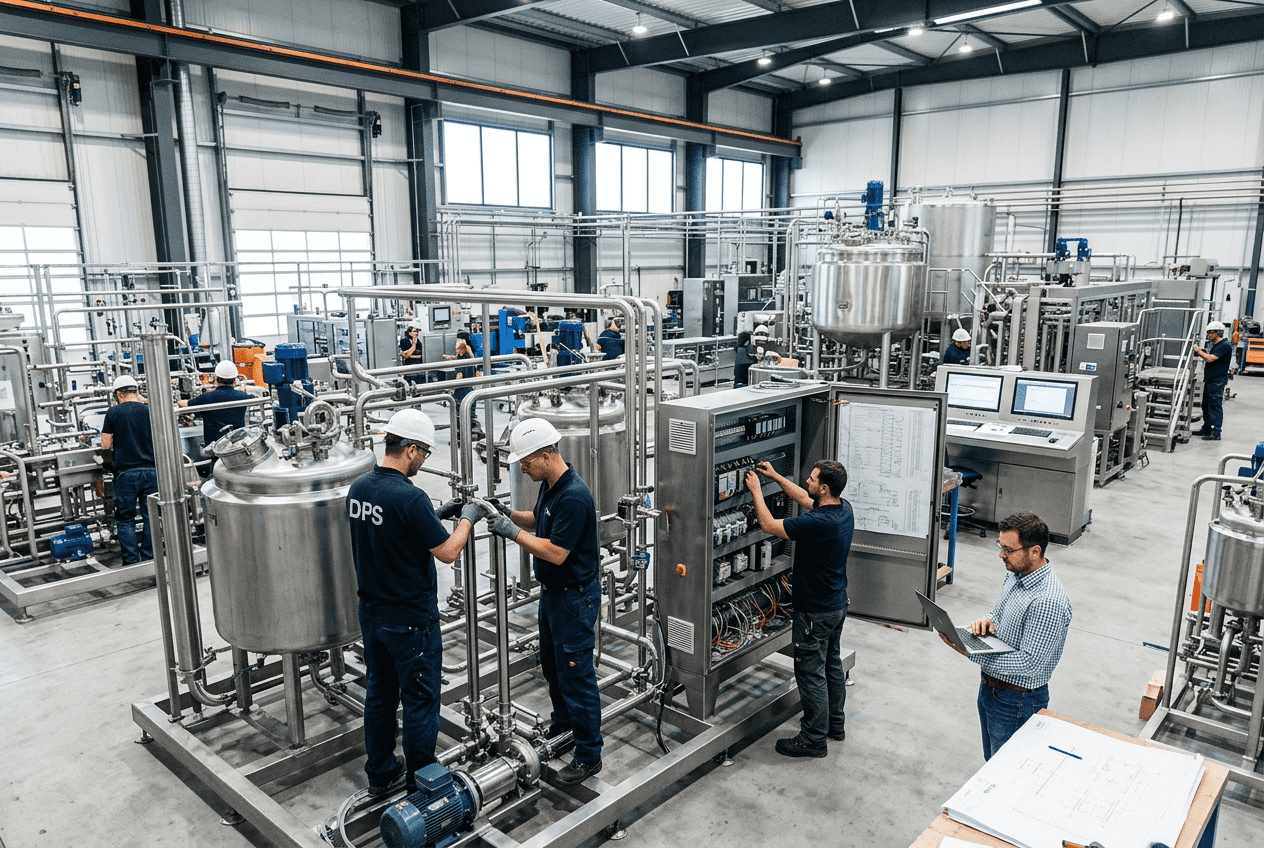
DPS installs, pipes, wires, and commissions complete food and beverage processing systems — from a single equipment line to an entire greenfield facility — under one contract, one schedule, and one accountable team. Because DPS engineers the process before installing it, every pipe run, utility connection, and control point is built exactly as designed, eliminating the field improvisation that inflates cost and delays production on conventionally bid projects.

Schedule A Consultation
Food processing equipment installation and system integration

DPS · Installation & System Integration

Construction Risk Factors

Challenges in Providing This Service in the Market

The installation phase is where food and beverage capital projects are most vulnerable. Engineering drawings transfer to a general contractor, who subcontracts mechanical piping to one firm, electrical to another, process equipment setting to a third, and controls wiring to a fourth. None of these subcontractors participated in the process design. None of them understand why a specific pipe slopes at 1/8″ per foot toward a drain point, why a valve actuator needs to be oriented for CIP return flow sequencing, or why a utility header was sized for a future expansion phase that is not in their scope of work. The result is a construction site where trades collide, RFIs multiply, and the owner — who may lack a dedicated technical project manager — absorbs every coordination failure as a change order, a schedule delay, or a system that does not run correctly at startup.

  1. Challenge 01

    Design-to-field information loss

    When the firm that engineered the process is not the firm installing it, critical design intent is lost in the handoff. Pipe specifications get simplified, slope requirements get ignored for routing convenience, and instrument locations get moved to wherever the fitter finds room. These deviations may not surface until commissioning, when a CIP circuit will not drain, a temperature sensor reads inaccurately due to improper insertion depth, or a pump cavitates because suction piping was reconfigured in the field.

  2. Challenge 02

    Multi-contractor coordination burden

    On a typical mid-scale food facility project, the owner must coordinate between a mechanical contractor, an electrical contractor, a plumbing contractor, a controls integrator, a fire protection installer, and the equipment vendor’s startup technicians — six or more independent firms with separate schedules, separate shop drawing timelines, and competing claims to the same overhead space. Clash detection that should have happened in 3D modeling during engineering instead happens at 40 feet in the air with welders waiting.

  3. Challenge 03

    Commissioning and startup risk

    Equipment installation that is disconnected from process engineering produces systems that technically comply with the drawing set but do not function as an integrated production line. Utility capacities are not verified against simultaneous peak loads. Control interlocks between upstream and downstream equipment are tested in isolation rather than as a coordinated sequence. Manufacturers discover on day one of production that throughput, changeover times, or sanitation cycles do not meet the performance basis that justified the capital expenditure.

  4. Challenge 04

    Regulatory and food safety exposure

    Process piping installation in FDA- and USDA-regulated facilities demands strict adherence to sanitary welding procedures, material traceability, dead-leg elimination, and drainability standards. Mechanical contractors without food-industry specialization routinely install fittings, valve configurations, or piping geometries that create harborage points — deficiencies that food safety auditors will identify during SQF, BRC, or USDA pre-operational inspections and that require expensive remediation under operational time pressure.

The DPS Solution

Building Scalable and Efficient Production Systems

DPS performs physical installation and system integration as a continuous extension of the engineering that precedes it — not as a separate phase handed off to a separate organization. Within the Design-Build-Manage delivery model, the same DPS process engineers who developed your P&IDs, equipment specifications, and facility layout direct the installation scope: defining pipe routing, specifying weld procedures, sequencing equipment setting, coordinating utility tie-ins, and programming the controls that bring each system online. There is no handoff document, no reinterpretation of design intent by a third party, and no RFI cycle where field conditions force engineering rework weeks after the design was supposedly finalized.

Our installation execution is powered by a vetted national contractor network that DPS has qualified across all 50 states and Canada. DPS functions as the general contractor or construction manager on each project, deploying trade partners for mechanical piping, electrical, plumbing, structural steel, insulation, and specialty disciplines while retaining direct control over process piping installation, equipment setting and alignment, controls wiring, and system commissioning. This hybrid model delivers the on-the-ground trade capacity of a large regional contractor with the process engineering intelligence of the firm that designed the system — a combination that virtually no single contractor in the U.S. food and beverage construction market can replicate.

System integration at DPS means more than connecting equipment to utilities. It means verifying that every process line operates as a coordinated production system before the owner takes possession. DPS commissioning protocols test each unit operation individually, then validate integrated sequences — CIP circuits across multiple zones, batch control handoffs between upstream blending and downstream filling, simultaneous utility peak loads on steam, compressed air, glycol, and process water — under conditions that replicate actual production. The facility you receive on turnover day is not a collection of individually tested components; it is a functioning production line with verified throughput, documented sanitation cycles, and trained operators.

Key Capabilities

Capabilities Supporting Modern Production Operations

Integrated engineering, operational, and project capabilities designed to support efficient, scalable, and reliable production environments.

PLC Programming & Logic Development

Custom ladder logic, structured text, and function block programs developed on Allen-Bradley, Siemens, and other major platforms for process control, safety interlocks, and high-speed sequencing across food and beverage unit operations.

SCADA System Design & Deployment

Full supervisory control and data acquisition architecture including server configuration, real-time process visualization, historical trending, and role-based access designed for multi-line F&B production environments.

Recipe Management & Batch Control

ISA-88-aligned recipe structures that allow production teams to manage formulations, ingredient scaling, and batch sequencing directly from the HMI — reducing changeover time and eliminating manual transcription errors.

CIP/SIP Automation & Validation

Automated clean-in-place and sterilize-in-place sequences with full parametric data logging for FDA and USDA compliance, integrated with process scheduling to minimize non-productive time between production runs.

Energy & Utility Management Systems

Real-time monitoring and automated control of boiler, compressed air, glycol, refrigeration, and HVAC systems to reduce per-unit energy cost while maintaining critical environmental parameters in temperature-sensitive processing areas.

Controls Integration & Retrofits

Integration of new automation layers into existing brownfield facilities — migrating legacy relay logic or outdated DCS platforms to modern PLC/SCADA infrastructure without extended production shutdowns.

The DPS Integrated Advantage

Engineering Scope & Deliverables

DPS installation and system integration engagements are scoped as defined work packages with specific deliverables at each phase. The following table outlines our standard installation disciplines, scope boundaries, and documentation deliverables for a typical food or beverage processing facility project.

Scroll horizontally to compare every column on smaller screens.

Installation DisciplineScope of WorkOwner Deliverables
Process PipingSanitary SS tubing (orbital and manual TIG), industrial process piping, valve assemblies, expansion joints, pipe supports, insulation, slope verificationWeld logs with welder ID, borescope inspection reports, passivation certificates, pressure test records, as-built isometric drawings
Equipment SettingRigging, lifting, precision placement, anchor bolt installation, leveling, alignment, vibration isolation mountingEquipment placement records, laser alignment reports, anchor bolt torque documentation, seismic anchorage calculations
Mechanical UtilitiesSteam/condensate, compressed air, glycol supply/return, process water, wastewater, refrigeration piping, HVAC ductworkUtility load verification, pressure test records, insulation inspection, balancing reports, as-built utility drawings
Electrical PowerMain service entrance coordination, switchgear, panelboards, MCCs, VFDs, conduit and wire runs, grounding, arc flash labelingSingle-line diagram updates, panel schedules, wire pull sheets, megger test reports, arc flash study and labels per NFPA 70E
Instrumentation WiringField routing of instrument cables, junction boxes, instrument mounting, tubing runs for pneumatic actuatorsCable schedule, instrument location drawings, cable continuity test records, instrument calibration certificates
Controls IntegrationPanel termination, I/O point-to-point checkout, signal verification, network infrastructure, HMI/SCADA connectivityI/O checkout sheets (signed per point), network architecture documentation, panel as-built drawings
CIP System InstallationSupply and return piping to all CIP circuits, chemical delivery piping, spray device installation, drain verificationCIP circuit matrix, spray coverage verification, drain slope confirmation, chemical supply P&ID as-built
Commissioning & StartupHydrostatic/pneumatic testing, loop checks, functional testing per system, integrated sequence testing, CIP validation, operator walk-throughCommissioning protocol with pass/fail records, punch list resolution log, CIP validation report, operator training sign-off, substantial completion certificate

Project Planning Guide

Plan Installation & System Integration Around The Operating Requirement

Installation places equipment in the plant; integration makes that equipment work with utilities, controls, neighboring machines, and operating procedures. The distinction matters because a collection of installed assets is not yet a production-ready system.

The engineering solutions pillar connects this stage to the approved design basis and construction scope. Define the general contracting interfaces before equipment delivery so neither the building team nor the installer assumes the other owns a critical connection.

Confirm Installation Readiness

Review equipment dimensions, weights, lift points, access paths, foundations, and supplier instructions. Confirm delivery inspection, temporary storage conditions, protection of product-contact surfaces, and responsibility for rigging. Check whether the area is suitable for installation and whether subsequent work could damage the equipment.

Verify utilities at the required conditions and locations. Power supply, steam, compressed air, refrigeration, water, and drainage interfaces should match the equipment and process requirements. Document deviations rather than correcting them informally in the field.

For an equipment relocation, add condition records, labeling, preservation, and reassembly requirements to the readiness review. Existing equipment may not be suitable for a new duty simply because it operated successfully at the old site.

Manage Mechanical And Control Interfaces

Assign ownership of process piping, utility piping, electrical connections, instruments, networks, and software integration. Agree the information vendors must provide and when their support is needed. Sequence work so installation access, inspection, and cleaning remain possible.

Before energizing or introducing product, verify installation against the governing drawings and site procedures. Include device identification, signal checks, equipment rotation or movement where applicable, leak and pressure test requirements, and safety-system checks under qualified supervision.

Commission In Controlled Stages

Separate checks that can be completed without product from trials that depend on actual materials and operating conditions. A staged plan can include installation inspection, utility checks, field signal verification, functional testing, cleaning verification, and product trials. The sequence and approvals must suit the specific process.

Define the acceptance basis before testing begins. Throughput, recipe accuracy, cleaning performance, product quality, and operator readiness may require different methods and responsible teams. Record deviations and decide whether they prevent progression or can be managed through an approved action plan.

For line modernization, the commissioning plan also needs a production cutover, restart conditions, and a fallback decision. An optimistic startup date is not a substitute for an agreed readiness gate.

Define The Handover Package

Provide the information operations and maintenance need: current drawings, equipment manuals, software backups, configuration records, test results, spare-part lists, training records, and outstanding actions. Identify the support contact and boundaries for each system.

Review early production performance against the agreed basis rather than supplier nameplate rates alone. Record issues with enough detail to separate mechanical, process, controls, and operating causes. Use the company collaboration approach to keep those responsibilities connected.

Planning Checklist

Prepare:

  1. Equipment documentation, layouts, lifting needs, and delivery dates.
  2. Installation boundaries, vendor responsibilities, and utility readiness evidence.
  3. Mechanical, electrical, controls, and safety verification requirements.
  4. A commissioning sequence, test criteria, and production release authority.
  5. Operator training, maintenance information, backups, and handover records.

Keep “installed,” “commissioned,” and “accepted for operation” as distinct milestones. Each needs evidence and an identified owner.

Coordinate Utility and Startup Boundaries

Before a tie-in, establish the point-of-use utility requirements and the operating areas affected by isolation. Connect the work package to commissioning and startup acceptance so installation completion, test readiness, and production release remain separate decisions.
Project Verification Questions

Common Questions About Automation & Controls Service

Quick answers to the questions we hear most often from prospective clients evaluating automation partners.

Does DPS self-perform installation work, or do you subcontract to local trades?

DPS operates as the general contractor or construction manager on installation projects, directly managing all scope, schedule, and quality control. Process-critical disciplines — including sanitary process piping, equipment setting, controls wiring, and commissioning — are performed by DPS field personnel or long-term trade partners that DPS has qualified specifically for food and beverage work. General trade disciplines such as structural steel, electrical distribution, plumbing, and insulation are executed by vetted local contractors in each state, selected from a national network that DPS has built across all 50 states and Canada. Regardless of who performs the physical work, DPS engineers supervise installation quality against the project design and food safety requirements.

Can DPS install equipment that was not engineered or supplied by DPS?

Yes. While the highest-value integration occurs when DPS engineers the process and then installs it, we regularly perform equipment installation and process piping for client-furnished equipment or systems designed by third-party engineering firms. In these cases, DPS conducts a constructability review of the existing engineering documents before mobilization — identifying potential conflicts between the design, the physical facility conditions, and regulatory requirements — so that field issues are resolved at the drawing table rather than at construction labor rates.

What geographic areas does DPS serve for installation projects?

DPS performs installation and system integration projects across the entire United States and Canada. Our headquarters in Cary, North Carolina and West Coast office in Lake Forest, California provide project management coverage for both Eastern and Western time zones, while our national contractor network supplies qualified local trade labor in every region. DPS project managers and field engineers travel to the job site regardless of location, maintaining consistent quality standards and direct engineering oversight whether the project is in the Southeast, the Midwest, the Pacific Northwest, or anywhere in between.

How does DPS handle installation in an operating facility where production cannot stop?

Phased installation within active food and beverage production environments is a core DPS competency. We develop detailed construction phasing plans that isolate active work zones from operating production areas, schedule high-impact activities — utility shutdowns, overhead lifts, tie-ins to existing systems — during planned downtime windows, and coordinate all contractor access through the owner’s food safety and GMP protocols. Hot tie-ins to live utility systems are engineered and rehearsed before execution to minimize downtime duration. Every DPS field team operating in an active food facility follows site-specific hygiene, allergen control, and safety procedures established during the pre-construction planning phase.

What documentation does the owner receive at project completion?

DPS delivers a comprehensive turnover package that includes as-built drawings for all installed disciplines (process piping, electrical, instrumentation, utilities), equipment commissioning records, weld logs with inspection documentation, instrument calibration certificates, electrical test reports (megger, continuity, arc flash), CIP validation records, and a signed commissioning protocol documenting pass/fail results for every tested system and integrated sequence. This documentation package is structured to support regulatory inspections by FDA, USDA, and third-party food safety auditors conducting SQF, BRC, or FSSC 22000 certification audits — providing the traceable installation records that auditors require as evidence of a controlled, qualified construction process.

Connect Planning With Production

Industry Requirements & Project Context

Compare these decisions with the relevant industry requirements and published project examples. A case describes its own scope and outcome, not a performance commitment for a different facility.

Published Case

Golden West Food Group — Co-Packing Plant Relocation

DPS relocated Golden West Food Group’s co-packing plant from Los Angeles to Fort Worth in 10 weeks, with zero supply chain disruptions.

Review Project Context

Connect The Next Decision

From Planning To Execution

Bring Your Project Requirements Into Focus

Share your product mix, capacity targets, current constraints, and project timeline. Start a conversation about the scope and decisions your project needs.