Disruptive Process Solutions丨DPS
English

Service

Capital Planning and Feasibility Studies for Food Plant Investment

DPS turns food and beverage facility investment decisions into engineered financial models — grounded in real production data, validated utility costs, and phased expansion logic — so your capital delivers measurable returns, not expensive surprises. From single-line capacity upgrades to greenfield plant programs across all 50 U.S. states and Canada, our feasibility studies and capital planning services give executive teams the operational and financial clarity to commit with confidence.

Schedule A Consultation
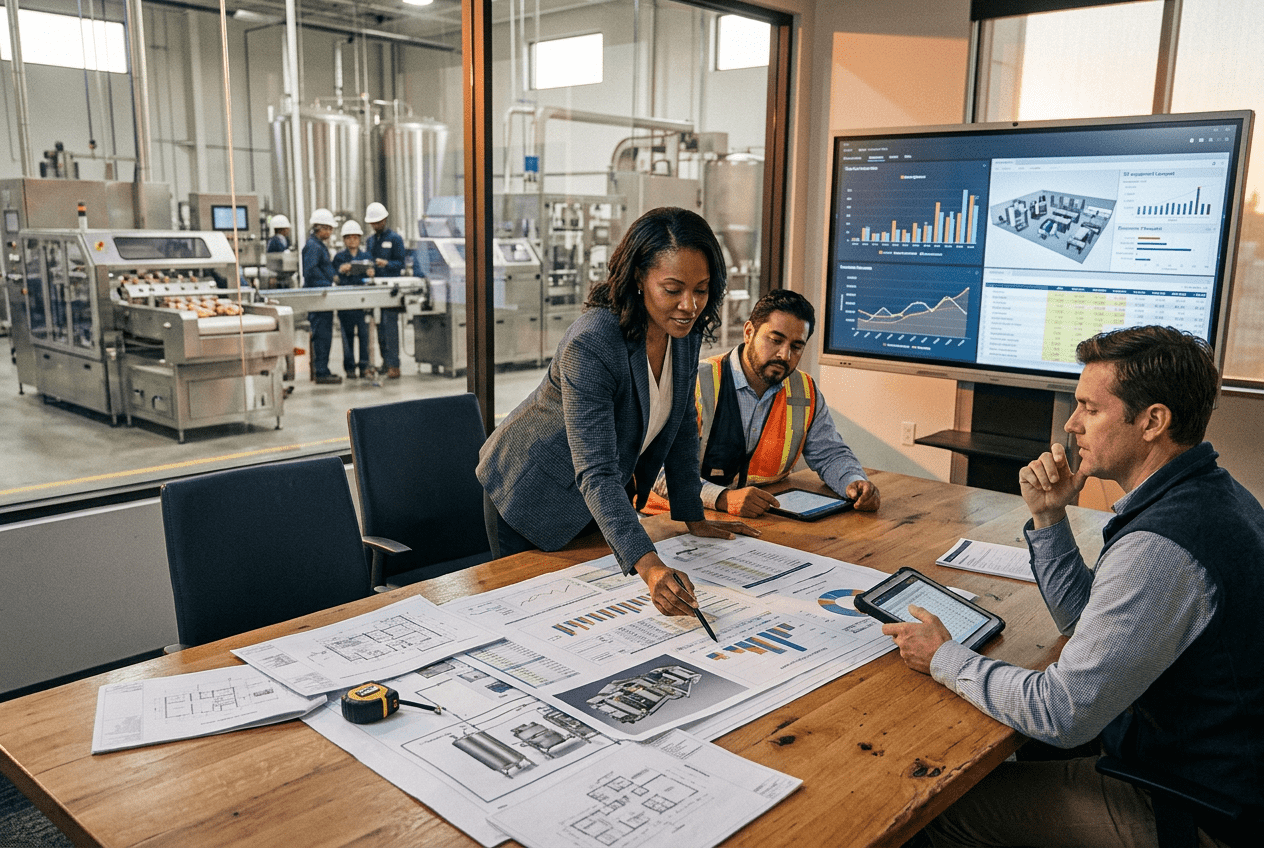
Capital planning for a food and beverage manufacturing project

DPS · Capital Planning & Feasibility

Construction Risk Factors

Challenges in Providing This Service in the Market

Food and beverage manufacturers rarely lose money on bad equipment. They lose money on bad decisions about when, where, and how much to invest — commitments made with incomplete production models, optimistic throughput assumptions, and capital budgets that ignore the true installed cost of utilities, regulatory compliance, and operational ramp-up. A feasibility study that relies on equipment vendor quotes and general contractor ballpark estimates instead of validated process engineering data will systematically understate total project cost by 15 to 30 percent. By the time the gap surfaces, the board has approved the budget, the lease is signed, and the operations team inherits a facility that cannot hit its ROI timeline without additional capital no one planned for.

  1. Challenge 01

    Vendor-driven scope inflation

    Equipment manufacturers scope what they sell, not what you need. Without an independent engineering-led feasibility analysis, capital plans accumulate specifications driven by supplier margin rather than your actual production requirements, batch volumes, and changeover frequency.

  2. Challenge 02

    Throughput projections disconnected from facility reality

    Business cases built on nameplate equipment capacity rather than real-world throughput accounting for CIP cycle time, changeover labor, utility recovery periods, seasonal demand variation, and sanitation downtime. The gap between theoretical and actual output is where ROI models collapse.

  3. Challenge 03

    Expansion with no phased infrastructure strategy

    First-phase capital approved without engineered provisions for Phase 2 and Phase 3 utility capacity, structural loading, floor space, and dock access. Each subsequent expansion triggers redundant mechanical and electrical work that could have been avoided with a phased capital roadmap from the outset.

  4. Challenge 04

    Compliance costs treated as contingency

    FDA, USDA, SQF, and BRC requirements estimated as a budget line item rather than engineered into scope. Wastewater treatment, allergen zoning, air handling, drainage slope, and sanitary material specifications carry hard costs that surface during construction — not during planning — when they are three to five times more expensive to resolve.

The DPS Solution

Building Scalable and Efficient Production Systems

DPS performs capital planning and feasibility studies as an engineering discipline, not a consulting exercise. Our process begins where most advisory engagements end: with your actual production data. We model your current-state operations — batch sizes, cycle times, labor deployment, utility consumption, CIP schedules, changeover protocols, and seasonal throughput patterns — to establish a validated baseline before any investment scenario is evaluated. This means your ROI analysis is anchored in how your facility actually performs, not in how a spreadsheet assumes it should.

From that operational baseline, our engineering team builds phased investment models that map every dollar of capital to a specific production outcome: additional throughput capacity, reduced per-unit operating cost, new product capability, or regulatory compliance positioning. Each scenario includes detailed utility load projections, equipment specifications, installation cost estimates derived from our own construction experience, and a realistic ramp-up timeline that accounts for commissioning, operator training, and initial production yield loss. Because DPS operates under a Design-Build-Manage model — with in-house process, mechanical, electrical, structural, plumbing, and controls engineering — our feasibility numbers are produced by the same team that will design and build the facility. There is no translation loss between the capital plan and execution.

This is also where DPS differs philosophically. Our pre-qualification process and business-first advisory role mean we will recommend operational improvements over capital projects when the data supports it. We have solved multi-million-dollar capacity problems with controls adjustments that cost nothing — and then earned the larger capital project when the client’s growth genuinely required it. The goal of every DPS feasibility study is to ensure that every dollar you spend on your food or beverage facility generates a return you can measure, defend to your board, and build upon.

Key Capabilities

Capabilities Supporting Modern Production Operations

Integrated engineering, operational, and project capabilities designed to support efficient, scalable, and reliable production environments.

PLC Programming & Logic Development

Custom ladder logic, structured text, and function block programs developed on Allen-Bradley, Siemens, and other major platforms for process control, safety interlocks, and high-speed sequencing across food and beverage unit operations.

SCADA System Design & Deployment

Full supervisory control and data acquisition architecture including server configuration, real-time process visualization, historical trending, and role-based access designed for multi-line F&B production environments.

Recipe Management & Batch Control

ISA-88-aligned recipe structures that allow production teams to manage formulations, ingredient scaling, and batch sequencing directly from the HMI — reducing changeover time and eliminating manual transcription errors.

CIP/SIP Automation & Validation

Automated clean-in-place and sterilize-in-place sequences with full parametric data logging for FDA and USDA compliance, integrated with process scheduling to minimize non-productive time between production runs.

Energy & Utility Management Systems

Real-time monitoring and automated control of boiler, compressed air, glycol, refrigeration, and HVAC systems to reduce per-unit energy cost while maintaining critical environmental parameters in temperature-sensitive processing areas.

Controls Integration & Retrofits

Integration of new automation layers into existing brownfield facilities — migrating legacy relay logic or outdated DCS platforms to modern PLC/SCADA infrastructure without extended production shutdowns.

The DPS Integrated Advantage

Engineering Scope & Deliverables

The table below outlines the standard phases, deliverables, and analytical parameters DPS addresses within a capital planning and feasibility engagement for food and beverage facility investment programs.

Scroll horizontally to compare every column on smaller screens.

Study PhaseDeliverablesAnalytical Parameters
Operational Baseline AssessmentCurrent-state production audit report, utility consumption profile, bottleneck identification summary, labor efficiency analysisActual OEE, throughput per shift, CIP cycle duration, changeover time, utility cost per unit of production
Market & Demand AlignmentDemand scenario matrix, SKU volume forecasting inputs, co-packing vs. owned-production analysisVolume projections mapped to production capacity by line, shift pattern, and seasonal peak/trough cycles
Conceptual Scope DevelopmentPreliminary facility layout options, major equipment list, utility system requirements, compliance scope summaryEquipment sizing against target throughput; FDA, USDA, SQF, BRC regulatory scope identification
Capital Cost EstimationTotal installed cost model with line-item breakdown: equipment, installation, utilities, controls, site work, compliance, soft costsCost data derived from DPS national project experience; contingency allocation by risk category
ROI & Financial ModelingInvestment scenario comparison, payback period analysis, NPV/IRR projections, sensitivity analysis on key variablesLabor cost, raw material cost, utility rates, throughput yield, and ramp-up timeline as variable inputs
Phased Expansion PlanningMulti-phase capital roadmap with infrastructure pre-investment specifications, trigger milestones, and budget allocations per phaseUtility headroom per phase, structural pre-loading, reserved floor space, permitting timeline per jurisdiction
Executive Decision PackageBoard-ready summary report, risk register, recommendation with go/no-go criteria, preliminary project scheduleAll assumptions, data sources, and engineering basis of estimate documented for stakeholder review

Project Planning Guide

Plan Capital Planning & Feasibility Around The Operating Requirement

Capital planning connects a manufacturing opportunity to a defensible project scope. Buying additional equipment may be one option, but changing the product schedule, improving an existing constraint, or staging an expansion may solve a different part of the same problem. Feasibility work makes those choices visible before significant commitments are made.

Use the engineering solutions pillar to see how planning connects to design and execution, and the manufacturing scenarios pillar to compare the operating situations that shape each investment.

Frame The Investment Decision

Start with the business question: which demand, quality, cost, or resilience requirement is the current operation unable to meet? Separate confirmed orders and existing performance from forecasts and assumptions. Define the time horizon, decision owner, and criteria used to compare alternatives.

A useful baseline includes production by product family, available operating hours, downtime reasons, changeover duration, labor coverage, yield, and utility consumption. Without this baseline, an apparently attractive equipment rate may not translate into saleable output.

Compare Practical Alternatives

Evaluate a small set of meaningfully different options rather than variations of the same equipment purchase. An existing-site capacity expansion may use infrastructure already available. A greenfield facility may offer a different layout and growth path, but introduces site, utility, construction, and startup dependencies.

For each option, document:

  • The capacity and product flexibility it is expected to support.
  • Site and utility prerequisites, including any external dependencies.
  • Construction access and production interruption assumptions.
  • Staffing, sanitation, maintenance, and ongoing operating needs.
  • The uncertainty in scope, cost, schedule, and demand.

Identify information gaps that could change the decision. A utility survey or equipment condition assessment can be more valuable at this stage than a highly detailed rendering of an unconfirmed layout.

Model Total Project And Operating Cost

An equipment quotation is only one part of capital cost. Include installation, utilities, controls, building modifications, professional services, commissioning, training, temporary arrangements, and contingency appropriate to the definition of the scope. Distinguish allowances from priced commitments.

Operating models should consider labor, cleaning, maintenance, energy, consumables, waste, and inventory effects. Test sensitivity to demand, product mix, uptime, yield, and startup duration. Report the assumptions behind any payback or return calculation; a calculated result is not a guarantee.

Make Expansion Phases Explicit

Where investment is staged, define what each phase must deliver independently. Reserve space and connection points only where the future requirement is credible. Avoid describing a later phase as “easy” until its utility capacity, shutdown needs, and installation access have been reviewed.

Establish Decision Gates

Set review points for the design basis, funding authorization, procurement, execution readiness, and operational handover. Each gate needs an owner, evidence, and a way to handle changes. Owner’s representation can provide a framework for coordinating these interfaces and reporting decisions to the manufacturer.

The DPS delivery comparison provides context for the Design-Build-Manage model. Project-specific roles, deliverables, and commercial responsibilities still need to be agreed in the actual scope.

Planning Checklist

Bring a concise investment brief containing:

  1. The problem, demand assumptions, and measurable operating baseline.
  2. Alternatives considered, including an existing-operation improvement option.
  3. Preliminary layouts, utility needs, and site constraints.
  4. Capital and operating estimates with exclusions and uncertainty recorded.
  5. Funding limits, timing constraints, approval owners, and next investigations.

If the business case depends on uninterrupted output during construction, review the expansion shutdown strategy before adopting that assumption.
Project Verification Questions

Common Questions About Automation & Controls Service

Quick answers to the questions we hear most often from prospective clients evaluating automation partners.

How is a DPS feasibility study different from what a consulting firm or equipment vendor provides?

DPS feasibility studies are produced by the same process, mechanical, electrical, and controls engineers who will design and build the facility. This means our cost estimates, utility projections, and timeline assumptions are derived from direct construction experience across food and beverage projects nationwide — not from industry benchmarks or vendor quotes assembled by analysts without installation-level knowledge. When DPS estimates a total installed cost, that number reflects what we have actually built, not what a database suggests it should cost.

What is the typical timeline and investment for a capital planning engagement?

Most DPS feasibility and capital planning engagements run four to eight weeks depending on scope complexity, number of investment scenarios evaluated, and whether an on-site operational baseline audit is included. Project budgets vary with facility scale, but DPS typically engages with food and beverage manufacturers on projects ranging from $400K targeted upgrades through $5M-plus full-facility programs. The feasibility study investment is a fraction of the capital at risk — and routinely pays for itself by eliminating a single scope gap that would otherwise surface during construction.

Will DPS recommend against a capital project if the data does not support it?

Yes — this is a core principle of our practice. DPS pre-qualifies every engagement and operates as a business-first advisor, not a contractor seeking construction revenue. If our analysis reveals that an operational adjustment, controls upgrade, or scheduling change can solve the capacity problem without a capital project, we will present that finding directly. We have resolved multi-million-dollar throughput constraints with PLC logic adjustments at no charge to the client, then earned the larger facility project when genuine growth demanded it.

Can DPS produce a feasibility study for a facility in any U.S. state?

DPS delivers capital planning and feasibility services across all 50 states and Canada. Our engineering analysis — production modeling, cost estimation, ROI projections, phased roadmapping — is performed by our in-house team from offices in Cary, NC and Lake Forest, CA. For engagements requiring on-site operational audits, our engineers travel to your facility regardless of location, and our vetted national contractor network provides region-specific installation cost data.

How does DPS account for FDA, USDA, and third-party audit requirements in the capital plan?

Regulatory and food safety compliance costs are engineered into every DPS feasibility study as defined scope items — not estimated as contingency line items. Our team identifies the specific FDA, USDA, SQF, BRC, HACCP, and FSMA requirements that apply to your product type and facility classification, then prices the associated infrastructure: sanitary construction materials, drainage systems, allergen zoning, air handling, wastewater treatment, and documentation. This prevents the 15-to-30-percent cost overruns that typically occur when compliance scope is discovered during construction rather than planned during feasibility.

Connect Planning With Production

Industry Requirements & Project Context

Compare these decisions with the relevant industry requirements and published project examples. A case describes its own scope and outcome, not a performance commitment for a different facility.

Published Case

Golden West Food Group — Co-Packing Plant Relocation

DPS relocated Golden West Food Group’s co-packing plant from Los Angeles to Fort Worth in 10 weeks, with zero supply chain disruptions.

Review Project Context

Connect The Next Decision

From Planning To Execution

Bring Your Project Requirements Into Focus

Share your product mix, capacity targets, current constraints, and project timeline. Start a conversation about the scope and decisions your project needs.