Disruptive Process Solutions丨DPS
English

Equipment

Tumblers & Marinators

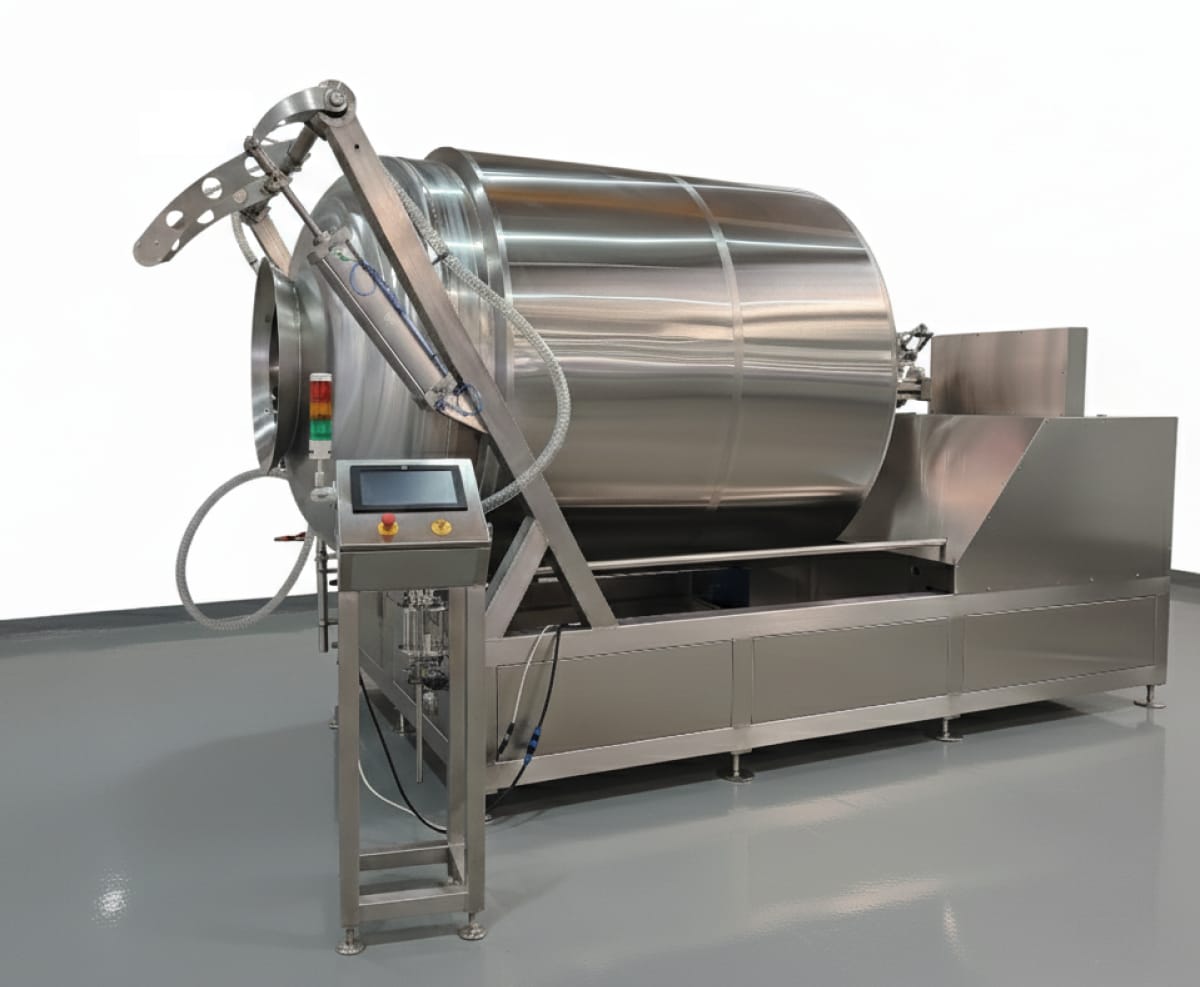
DPS designs and fabricates vacuum tumblers and marination systems as fully integrated components of your protein processing facility — not isolated catalog purchases. When your tumbler manufacturer is the same engineering team that designs your process flow, utility connections, automation controls, and upstream/downstream equipment, every cycle parameter is optimized for your specific product, your throughput targets, and your USDA-inspected production environment.

Discuss Your Equipment Requirements
Industrial tumblers and marinators

DPS · Tumblers & Marinators

Equipment Overview

Protein Marination Equipment Designed Around Your Process — Not a Catalog Selection

Tumblers and marinators are the critical intersection of flavor, yield, and throughput in every protein processing operation. A properly engineered meat tumbler applies controlled mechanical action — rotation, tumbling, and vacuum cycling — to drive brine, marinades, and seasoning solutions deep into muscle fiber, producing consistent flavor penetration, improved bind, and measurable yield gains across beef, pork, poultry, seafood, and plant-based protein lines. The physics are straightforward, but execution demands precision: drum geometry, baffle configuration, rotation speed, vacuum depth, cycle timing, and temperature control must all be calibrated to the specific protein, the specific marinade viscosity, and the specific production target. Generic, off-the-shelf tumblers force processors to adapt their recipes and line speeds to the machine. DPS builds tumblers that adapt to the process.

DPS manufactures industrial vacuum tumblers and marination systems in-house because marination performance is a direct function of how the equipment interfaces with upstream brine preparation, downstream portioning or packaging, and plant-wide CIP and refrigeration infrastructure. When a single engineering team designs the tumbler, the brine mixing system, the CIP circuits that clean it, and the automation that sequences it all, every variable is accounted for before fabrication begins. This single-source approach eliminates the integration gaps that plague multi-vendor equipment floors — mismatched discharge heights, incompatible control protocols, orphaned utility connections — and gives operations teams one phone number to call when they need recipe adjustments, throughput optimization, or expansion support anywhere in the United States or Canada.

Applications & Industries

Equipment Applications Across Food and Beverage Manufacturing

1

Sauces, Marinades & Dressings

Cooking kettles are the production backbone for tomato-based sauces, vinaigrettes, hot sauces, cheese sauces, and shelf-stable marinades. DPS specifies jacket capacity, agitator geometry, and steam flow rates to hit precise cook temperatures and hold times required by each product’s scheduled process, while high-shear agitation options ensure emulsion stability and particle-size consistency across batches ranging from pilot scale to full production volumes.

2

Soups, Stews & Prepared Foods

Chunked-ingredient products such as soups and stews demand gentle agitation that maintains piece integrity while preventing scorching on the heat-transfer surface. DPS kettles for prepared foods applications incorporate slow-speed sweep agitators with PTFE scraper blades, zoned jacket heating to prevent localized hot spots, and large-diameter bottom outlets that discharge whole vegetable and protein pieces without damage.

3

Dairy Processing

From pasteurized fluid milk bases and cultured products to cheese sauce, yogurt premixes, and ice cream bases, dairy applications require kettle specifications that satisfy both thermal performance and 3-A Sanitary Standards. DPS builds dairy kettles with electropolished product-contact surfaces, sanitary agitator shaft seals, CIP-ready nozzle configurations, and temperature instrumentation validated for HACCP critical control point monitoring.

4

Confectionery & Sweetened Products

Sugar syrups, caramel, toffee, and fruit fillings require precise temperature ramping to achieve target Brix concentrations without scorching or crystallization. DPS configures cooking kettles for confectionery with high-pressure jacket ratings for rapid heat delivery, programmable multi-stage cook profiles, and scrape-surface agitation that keeps viscous product moving continuously across the heated wall.

5

Co-Packing & Contract Manufacturing

Contract manufacturers running dozens of SKUs across multiple product categories need cooking kettles that change over rapidly and document every batch electronically for multi-standard audit compliance. DPS builds multi-recipe automation into the kettle’s PLC and SCADA architecture, enabling push-button recipe selection, automatic CIP sequencing between product changeovers, and electronic batch records that satisfy SQF, BRC, and retailer-specific food safety audit requirements simultaneously.

System Specifications

System Specifications and Design Parameters

Scroll horizontally to compare every column on smaller screens.

ParameterSpecification
Drum Working Capacity200 to 12,000 gallons; sized to match batch weight targets and production schedule requirements
Materials of Construction304 and 316L stainless steel; all product-contact surfaces polished to ≤32 Ra µin finish or better
Drum Drive & SpeedVariable-frequency drive (VFD) with adjustable rotation speed from 2 to 16 RPM; forward, reverse, and intermittent cycle programming
Vacuum SystemIntegrated vacuum pump capable of achieving and holding 25–29 inHg; automatic vacuum monitoring with leak detection and alarm
Internal Baffle DesignConfigurable baffle height, angle, count, and profile — optimized per product type (whole muscle, tumbled pieces, ground/formed) to control mechanical action intensity
Loading & DischargeFront-loading door with sanitary seal; hydraulic or pneumatic tilt discharge available for rapid unloading; optional bottom discharge valve for brine recovery
Temperature ManagementJacketed drum option for glycol or chilled water circulation; maintains product temperature below 40°F during extended marination cycles per USDA cold-chain requirements
Controls & AutomationPLC-controlled cycle management with HMI touchscreen; recipe storage for multiple product SKUs; SCADA integration, electronic batch records, and data logging
Sanitary Design3-A Sanitary Standards principles; fully drainable construction, no horizontal ledges, sealed bearings, tool-free removable baffles for inspection and cleaning
Regulatory ComplianceDesigned for USDA FSIS inspection environments, FDA 21 CFR Part 117, HACCP/HARPC compatibility, SQF and BRC audit readiness
CIP/COP CompatibilityIntegrated spray nozzle bosses for clean-in-place operation; designed to coordinate with DPS-engineered CIP systems or existing facility CIP infrastructure
Documentation PackageGeneral arrangement drawings, electrical schematics, weld records, material certifications, O&M manual, FAT protocol, and commissioning support

Project Planning Guide

Plan Tumblers & Marinators Around The Operating Requirement

Tumblers and marinators affect uptake, tenderness, yield, batch time, labor, and sanitation. DPS evaluates the machine as part of the complete protein or prepared-food line, including loading, vacuum, ingredient addition, discharge, cleaning, and downstream handling.

Define The Product Result

Record product dimensions, mass, temperature, formulation, target uptake, texture, batch size, and allowable dwell time. Confirm how product enters and exits, how ingredients are added, and which product-contact surfaces need inspection or special cleaning.

Balance The Line

Match tumbler working volume and cycle time to upstream preparation, marination supply, cooking, chilling, packaging, and sanitation windows. Evaluate loading ergonomics, lift or dump requirements, floor space, access, and maintenance removal routes.

Integrate Vacuum, Recipes, And Cleaning

Define vacuum levels, agitation profiles, ingredient sequencing, alarms, recipe permissions, and recovery behavior. Coordinate controls with the automation guide and confirm cleanability, drainage, gasket access, and verification with the site quality team.

Planning Checklist

  1. Product, formulation, batch size, uptake, texture, and temperature basis.
  2. Vacuum, agitation, loading, discharge, cycle, and utility requirements.
  3. Line balance, labor, ergonomics, access, and maintenance constraints.
  4. Sanitary design, cleaning method, inspection, and verification needs.
  5. Controls narrative, FAT/SAT, training, spares, and acceptance criteria.

Choose tumbler capacity and features around the required product result and the line’s real operating rhythm.
Project Verification Questions

Common Questions About Tumblers & Marinators

What is the typical lead time for a custom DPS tumbler?

Lead times generally range from 12 to 20 weeks depending on drum capacity, jacket requirements, baffle customization, and the level of automation integration. A standard mid-range tumbler with VFD drive and basic PLC controls trends toward the shorter end of that window. Large-capacity jacketed units with full SCADA integration, multi-recipe programming, and custom discharge configurations require longer engineering and fabrication schedules. For clients engaged in a full Design-Build-Manage facility project, tumbler delivery is coordinated against the master construction timeline so the unit arrives for installation precisely when the production area is ready — avoiding both storage costs and schedule delays.

Can DPS size a tumbler for my specific batch weight and production schedule?

Every DPS tumbler starts with your product and your numbers. Our process engineers calculate the required drum working volume based on your target batch weight, product bulk density, recommended fill percentage (typically 40–60% of total drum volume to allow proper tumble action), and the number of cycles per shift needed to meet daily throughput goals. This approach ensures the tumbler is neither oversized — wasting floor space, energy, and capital — nor undersized, which would force additional cycles that bottleneck the production schedule and compress cook and chill time downstream.

How does vacuum tumbling improve marination yield and product quality?

Operating under vacuum — typically 25 to 29 inches of mercury — opens the cellular structure of muscle fiber and removes trapped air from the product surface, allowing brine and marinade to penetrate more rapidly and more uniformly than atmospheric tumbling alone. The result is higher and more consistent pickup percentages, reduced purge loss during subsequent cooking, and improved color and texture uniformity across the batch. For processors where a single point of yield improvement across millions of annual pounds translates directly to six-figure profit gains, vacuum tumbling is not optional — it is a core process requirement that DPS engineers into the system from the start.

Does the tumbler integrate with my existing facility controls and CIP system?

Yes. DPS tumbler controls are built on standard industrial PLC platforms and communicate via EtherNet/IP, Modbus TCP, or other common industrial protocols, allowing seamless integration into your existing plant SCADA or MES architecture. For CIP, DPS tumblers include sanitary spray nozzle connections and fully drainable interior geometry. If your facility operates a DPS-engineered CIP system, the tumbler’s cleaning circuits are designed as part of the overall CIP schematic. If you have an existing third-party CIP installation, our engineers design the tumbler’s connections and drain configuration to interface with your current supply and return infrastructure.

What maintenance does a DPS tumbler require and what support is available?

Routine maintenance includes inspection of drum seals and door gaskets, lubrication of drive bearings per the scheduled intervals in the O&M manual, verification of vacuum pump oil levels and performance, and periodic calibration of temperature and vacuum sensors. DPS delivers a comprehensive operations and maintenance manual with every unit that includes a recommended spare parts list, preventive maintenance schedule, and troubleshooting guide. For clients under ongoing DPS project management or service agreements, our team can incorporate tumbler maintenance into facility-wide support scopes, ensuring sustained performance and audit readiness well beyond the commissioning date.

Connect Planning With Production

Industry Requirements & Project Context

Compare these decisions with the relevant industry requirements and published project examples. A case describes its own scope and outcome, not a performance commitment for a different facility.

Published Case

Ground Beef Line Execution — Confidential Client

DPS delivered a 350,000 lbs/week ground beef line in an active Los Angeles plant, coordinating 12 subcontractors and early production by Week 11.

Review Project Context

Connect The Next Decision

Solution

Automation & Controls

Define how the process should behave before developing control software, then connect recipes, alarms, interlocks, operator workflows, and testing to that intent.

Key decision: Clarify the operating sequence and failure response before choosing a software feature or control platform.

Planning Checklist for Automation & Controls

Integrated Equipment Delivery

Discuss Your Equipment Requirements

Share your product mix, capacity targets, current constraints, and project timeline. Start a conversation about the scope and decisions your project needs.